Why tokenization is dismantling the one layer the industry spent fifty years consolidating, and what that means for exchanges
Philip Filhol, Senior Business Development Manager at 21X
In “Which Ledger Are You Actually Tokenizing?” I mapped the four layers of the securities custody stack and argued that each layer produces a structurally different token. In “Why Every Asset Manager Needs a Digital Twin” I argued that an issuer who wants to reach the full spectrum of on-chain investors needs two products, not one: A natively tokenized instrument for the regulated perimeter and a debt wrapper for the permissionless one.
Both pieces were written from the issuer’s perspective. This one takes the infrastructure view, and it starts from an uncomfortable observation. If every asset manager follows the two-path logic, and if every layer of the custody stack produces its own token, and if each of those tokens is issued on whichever ledger its provider happens to prefer, then the market does not converge on a tokenized version of today’s system. It multiplies into something structurally different: Many parallel settlement systems, many parallel forms of cash, and many potentially non-fungible representations of the same asset.
That is not an incremental change in market structure. It is the reversal of the single most important design decision in modern capital markets.
The fifty-year consolidation
It is worth remembering what the settlement layer looked like before it was consolidated, because the industry has largely forgotten.
In the late 1960s, US equity volumes outgrew the paper certificate. Brokers physically carried certificates between offices. Reconciliation failed at scale. At the peak of what became known as the paperwork crisis, in 1968, the New York Stock Exchange closed on Wednesdays so back offices could catch up, and a significant number of member firms failed outright, not because they were unprofitable but because they could not settle their trades.
The institutional response was to remove settlement from competition entirely. The Depository Trust Company was created in 1973 to immobilize certificates in a single central location. The National Securities Clearing Corporation followed in 1976 to net obligations multilaterally before settlement. The two combined into DTCC in 1999. Europe took longer and a different route, moving from the Giovannini reports on cross-border settlement barriers to CSDR and finally to TARGET2-Securities, which since 2015 has provided a single technical settlement platform for the CSDs that joined it.
The architecture that emerged from those decades has a clear and deliberate shape:
Compete above. Consolidate below.
Execution was allowed, and later actively encouraged, to fragment. Regulation NMS in the US and MiFID in Europe produced dozens of exchanges, ATSs, MTFs, systematic internalizers and dark pools competing for the same order flow. That fragmentation was tolerable, and arguably beneficial, for one reason: Every one of those venues settled into the same depository, against the same central bank or commercial bank cash, in the same legally identical instrument.
This is the point that matters most for what follows. A consolidated tape and a national best bid and offer are only constructible because the security traded on venue A is the identical fungible instrument as the security traded on venue B. Fragmentation of execution across venues is a routing problem. It is solvable with technology, and it has been solved. Fragmentation of the instrument itself is a different category of problem, and it is the one tokenization is now creating.
TradFi and DLT capital markets, side by side
|
Dimension |
Traditional capital markets |
Tokenized capital markets today |
|
Settlement venue |
One CSD per market. DTC in the US, T2S-connected CSDs in the euro area |
Many ledgers in parallel: Canton, Stellar, Besu-based enterprise chains, Ethereum, Solana, and others |
|
Settlement asset |
Central bank money, or commercial bank money through one payment system |
Stablecoins, tokenized bank deposits, tokenized money market funds, and central bank money via the Eurosystem’s Pontes solution, launched in September 2026 |
|
Record of legal title |
CSD book entry, with the issuer register held by a registrar or nominee |
Three competing models: CSD-issued tokenized entitlement, transfer agent native register, or an SPV note under a DLT-native securities law |
|
Instrument fungibility |
One ISIN, one fungible pool, tradeable on any venue |
The same underlying exists as several non-fungible representations that cannot be netted against each other |
|
Settlement finality |
Defined in law at a designated system under the Settlement Finality Directive or equivalent |
Defined per ledger, per legal wrapper, per jurisdiction, and not always defined at all |
|
Asset servicing |
Standardized and centralized through the CSD |
Per issuer, per transfer agent, per chain, through bespoke smart contract logic |
|
Messaging standards
|
ISO 15022 and ISO 20022 over a single network |
No universal standard. Competing token standards, competing compliance frameworks, competing bridges |
|
Integrations required by a venue |
One CSD and one CCP per market |
Every transfer agent, multiplied by every chain, multiplied by every settlement asset |
|
Netting |
Multilateral netting through a CCP, compressing the obligations that actually require settlement by a large multiple |
No netting layer exists across different asset representations and blockchain networks |
Three axes of fragmentation, not one
Most commentary treats this as a chain problem: Too many blockchains, not enough interoperability. That framing is too narrow. Chain choice is only one of at least three independent axes, and because they are independent, the complexity they generate is multiplicative rather than additive.
Axis one: The issuance model
There are now three structurally different ways to put the same underlying security on-chain, and all three are live.
The custodial model keeps the legal record inside the existing depository and issues a tokenized entitlement against it. DTC demonstrated its tokenization service in a live production environment on July 15, 2026, with production launch expected in Q4 2026. Eligible assets include select Russell 1000 equities, ETFs tracking major indices and US Treasury bills, notes and bonds held at DTC.
The transfer agent native model moves the register itself. Securitize maintains the official record for BlackRock’s tokenized share classes and was named by NYSE in March 2026 as the first digital transfer agent eligible to mint blockchain-native securities on its planned Digital Trading Platform. Superstate registered its own digital transfer agent with the SEC. Computershare, the largest stock transfer agent in the world, partnered with Securitize in April 2026. New entrants such as OpenAgent registered specifically to serve tokenized markets. Here the token is the security, not a representation of it.
The wrapper model issues a debt instrument that replicates the economics of the underlying, typically as a Swiss Registerwertrecht, as described in the previous piece. Ondo Global Markets and xStocks both operate this way. The token is a bearer-style claim against an SPV.
Three models. One underlying. Three legally distinct instruments.
Axis two: The ledger
Each of those models then chooses where to live, and increasingly chooses more than one place. DTCC has explicitly adopted a multi-chain strategy, naming Stellar as the first public blockchain in its rollout in May 2026 and building its Collateral AppChain on Hyperledger Besu. Canton hosts a large share of institutional privacy-sensitive activity. The wrapper issuers deploy across Ethereum, Solana and several Layer 2s simultaneously.
None of these ledgers has native legal or operational equivalence with any other. A token on Stellar and the same product on Ethereum are separate positions with separate settlement paths until something explicitly links them.
Axis three: The cash leg
This is the axis most often left out of the analysis, and it is the one that determines whether delivery versus payment works at all.
A venue settling tokenized securities today must decide which forms of digital cash it will accept. The realistic list already includes dollar and euro stablecoins from multiple issuers, tokenized commercial bank deposits, tokenized money market fund shares used as a settlement and collateral asset, and central bank money via the Eurosystem’s Pontes solution, launched on September 21, 2026, linking DLT platforms to TARGET Services. Swift announced in July 2026 that its blockchain-based ledger was ready for initial use, with seventeen banks across six continents preparing to pilot live transactions using tokenized deposits held on each bank’s own ledger.
Every one of these is a different credit exposure, a different liquidity profile, a different redemption mechanism, a different legal characterization, and a different set of chains it is actually deployed on.
The multiplication
Using the simplified categories shown in the ecosystem map—three issuance models, four ledger buckets and four settlement asset categories—produces forty-eight illustrative settlement paths for a single asset. In the traditional model, the equivalent number for a venue operating in one market is one.
This is what the ecosystem map actually shows once you read it as a grid rather than a stack. Every trading venue at the top must reach every combination below it.
Ecosystem map
Fungibility is the deeper problem
Integration count is the visible problem. Fungibility is the structural one.
Under Reg NMS or MiFID, when the same security trades on fifteen venues, arbitrage between those venues is nearly frictionless. The instrument is identical, the settlement destination is identical, and a market maker can be long on one venue and short on another with no basis risk beyond execution latency. Fragmented liquidity is therefore effectively unified liquidity, stitched together by arbitrageurs and made visible by a consolidated tape.
Now consider the same underlying equity existing as a DTC tokenized entitlement on one chain, as a transfer agent native share on another, and as an SPV-issued tracker note on a third. A market maker holding the wrapper cannot deliver it against a sale of the entitlement. Moving between the representations is not a transfer, it is a conversion: A redemption and a fresh subscription, or a lock-and-mint through a gateway, each with its own latency, cost, counterparty exposure and operating hours. During that window the arbitrageur carries genuine basis risk.
The consequence is that the three books do not converge into one. They stay separate, each thinner than the single book would have been, each with wider spreads, each with its own price. There is no consolidated tape that can be constructed across them, because a consolidated tape presumes a common instrument. What we would need instead is a conversion mechanism reliable enough to make three instruments behave like one, and that mechanism does not currently exist at institutional quality.
Netting compounds this. The traditional system runs multilateral netting through a CCP precisely because netting is what makes settlement affordable at scale. Atomic gross settlement, trade by trade, removes that compression and raises the liquidity a participant must hold to trade the same notional. When the same economic exposure is split across three non-fungible representations, there is nothing to net even in principle, because the obligations are not obligations in the same instrument.
Why this lands hardest on exchanges
Issuers experience fragmentation as a distribution question. Investors experience it as a wallet and access question. Trading venues experience it as an integration burden, and the economics of that burden are worse than they first appear.
Start with what an integration actually is. It is not an API key.
Legal. For each ledger the venue settles on, it needs a defensible answer to when a transfer becomes irrevocable and unconditional, and under which law. In Europe that question is not academic: the DLT Pilot Regime, CSDR and the Settlement Finality Directive all attach consequences to it. A finality opinion for Canton is not a finality opinion for Solana.
Compliance. Each transfer agent operates its own whitelist, its own eligibility criteria and its own onboarding process. The previous piece made this point about DeFi protocols. It applies with more force to a regulated venue, because a venue must enforce eligibility pre-trade, for every participant, in every instrument, before an order is allowed to rest in the book. Ten transfer agents means ten compliance interfaces, and no two of them define an eligible holder the same way.
Risk. Every accepted settlement asset is a distinct credit and liquidity exposure requiring its own framework. Accepting a stablecoin, a bank deposit token and a tokenized money market fund is not one decision made three times. It is three separate risk policies, three sets of concentration limits, and three depeg or redemption scenarios to model.
Operations. Corporate actions, NAV publication, distributions and reconciliation all become per-issuer, per-transfer-agent and per-chain processes rather than a single standardized feed from a depository.
Technology. Node operation, key management, wallet infrastructure, reorganization handling and gas management, repeated for each ledger.
Now put the economics together. The cost of supporting the market scales linearly, at best, with the number of integrations. Revenue scales with liquidity, and liquidity is being divided across exactly the same dimensions that are driving the cost up. Each additional integration therefore costs more than the last and is expected to earn less.
A rational venue responds by under-integrating. It supports the chains and transfer agents that are already liquid and declines the rest. Issuers, observing this, issue where the venues already are. Liquidity concentrates where liquidity already is, and the fragmentation locks in rather than resolving. The self-reinforcing dynamic is not a market failure that competition will fix. It is the predictable equilibrium of a system where integration costs are bilateral.
There is a further problem that sits underneath all of this. If the securities leg settles on one ledger and the cash leg lives on another, delivery versus payment is not atomic. A venue has three options, and all three are unattractive. It can force both legs onto a single ledger, which constrains which assets and which participants it can serve. It can rely on cross-chain atomic protocols, whose legal finality characteristics are not yet settled. Or it can insert a settlement agent that takes principal risk in the middle, which reintroduces precisely the intermediary that tokenization was supposed to remove.
What an aggregation layer has to do
The industry has started to name this problem. In March 2026, DTCC, Euroclear and Clearstream published a joint white paper with BCG arguing that interoperability is a prerequisite for digital asset securities to scale, and that the end state will be a network of networks rather than a single dominant ledger, requiring common standards, gateways and regulated service providers. The IMF made a parallel argument in its April 2026 note on tokenized finance, observing that a pluralistic tokenized ecosystem makes interoperability a financial stability question rather than a technical one.
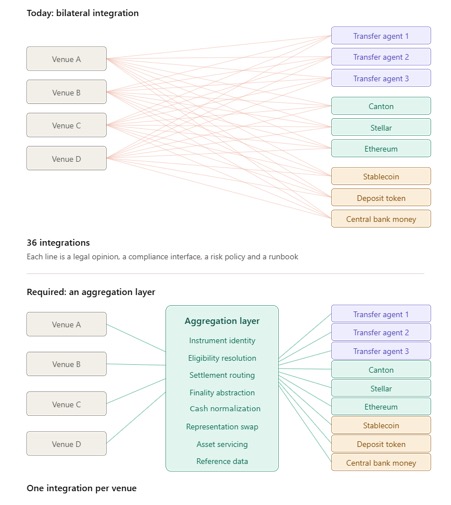
Naming the problem is not the same as specifying the solution. An aggregation layer that actually reduces a trading venue’s integration count from N to one has to perform at least seven functions:
1. Instrument identity and mapping. A registry that records what each token is a claim on, under which law, and critically which tokens represent the same underlying asset. An identifier standard plus a representation graph.
2. Eligibility resolution. A single interface through which a venue can query and satisfy transfer restrictions across many transfer agents, rather than building a bilateral compliance integration with each one.
3. Settlement routing and finality abstraction. The ability to send a settlement instruction to the correct ledger and receive back a confirmation that is legally meaningful, with the finality characteristics of that path made explicit rather than assumed.
4. Cash leg normalization. A way to treat several settlement assets as interchangeable at the point of settlement, with the credit and FX differences priced rather than ignored.
5. Conversion between representations. Gateways that move economic exposure between the custodial, native and wrapper forms. This is the function that actually restores fungibility, and it is by far the hardest.
6. Asset servicing normalization. Corporate actions, distributions and NAV data delivered in one format across issuers, representations and chains.
7. Reference data and reporting. Consolidated position, transaction reporting and tax data across the whole set.
Parts of this are being built, unevenly. The cash side is furthest ahead, because the incentives are clearest: Swift’s shared ledger is explicitly an orchestration layer above bank-issued tokenized deposits that remain on each bank’s own ledger, and Pontes is explicitly a bridge between DLT platforms and TARGET Services. On the securities side, DTCC’s ComposerX is a multi-chain issuance and settlement layer above a single depository, and Chainlink’s Digital Transfer Agent standard is an attempt to standardise the transfer agent interface itself, now adopted by DTCC for its Collateral AppChain. NYSE’s arrangement with Securitize is a venue building a transfer agent program directly, which is the bilateral approach done well rather than the aggregated approach.
None of these covers all seven functions. Among the securities-side candidates, incumbent market infrastructures face a structural bias: Their natural commercial instinct is to make their own network the hub through which the others connect.
That bias points at the real constraint. DTC could become the single settlement point for US equities because US securities law effectively made it one. There is no global equivalent of that legal authority, and there will not be one, because the ledgers now in question span jurisdictions with genuinely different laws on what a security is and when title transfers. The aggregation layer therefore cannot be a monopoly utility. It has to be a standard, implemented by a small number of interoperable operators, and adopted because it reduces cost rather than because it is mandated.
For a trading venue, the practical consequence is a decision that is coming sooner than most have planned for: Which aggregation layer to integrate with, before the integration burden of doing it bilaterally becomes the binding constraint on what the venue can list.
Where a regulated venue sits in this
There is one structural point worth making about the position of a licensed DLT venue in Europe, and it is a design point rather than a claim of superiority.
21X operates a regulated DLT trading and settlement system under the EU DLT Pilot Regime. Trading and settlement are not two institutions connected by a message; they are one system. That collapses several of the integration problems described above rather than solving them individually. There is one finality regime rather than a venue regime and a separate CSD regime. There is no instruction to a depository, because the venue is the settlement system. Multiple settlement assets can be admitted against a single order book without each one requiring a separate reconciliation path to an external cash system.
That is a partial aggregation layer by construction, on the settlement and cash dimensions. It is not a solution to the cross-representation fungibility problem, and no single venue can be. That problem needs conversion infrastructure that operates across venues, across transfer agents and across jurisdictions, which by definition is not something any one venue builds alone.
The View from Europe: Fragmentation by Design
Guest chapter by Markus Fehn, Head of Strategy & Innovation at Chartered Investment
Philip’s argument rests on an American memory: a paperwork crisis, a single depository created to end it, and fifty years in which settlement was simply not something you competed on. The question for this chapter is whether Europe is heading into the same re-fragmentation. The answer begins with a structural difference that is easy to forget: Europe never had that consolidation to reverse.
A platform was consolidated, not an institution
The United States answered 1968 with one institution. Europe answered the Giovannini reports with a platform. National CSDs had been settling in book-entry form against central bank money for decades before TARGET2-Securities existed; what T2S added was a shared technical layer beneath them. It took sixteen years. The Governing Council agreed it in 2008, migration ran in five waves from June 2015 to September 2017, and Euroclear Bank only joined in 2024. Even then the institutions did not merge: more than twenty CSDs operate on T2S as separate entities, with separate rulebooks and separate national securities laws underneath. That is not a story of institutions defending turf. Securities and property law in Europe is national, and a platform can be shared where a legal system cannot. “Compete above, consolidate below” arrived here in the only form the legal landscape allowed: a shared platform above independent institutions.
That starting point changes how tokenization lands. In the US, fragmentation of the settlement layer reverses a fifty-year design decision. In Europe it is closer to a return to form. The interesting question is not whether Europe fragments too. It is that Europe decided to fragment on purpose, by statute, and did so before most of the developments described above.
Germany de-monopolised the register by law
Since June 2021, the German eWpG allows securities to exist without a certificate: the security is the entry in a register. The law created two paths. A central register security stays close to the familiar model, with the register operated by a CSD. A crypto securities register, by contrast, may be operated by any firm holding the dedicated licence, on a distributed ledger of its choosing.
Read that against the three issuance models in this article and the mapping is almost exact. The central register security is the custodial model. The crypto securities register is the transfer agent native model, with a German particularity: the registrar does not maintain a record that points at a security kept elsewhere. The entry is the security. And the Swiss Registerwertrecht that powers the wrapper model sits directly across the border.
The market that grew out of this needs an honest description before a structural one: it is small. Cumulative issuance after five years is a rounding error next to conventional markets, and secondary trading is thinner still. That is the normal condition of early infrastructure, and it is not the interesting part. The structure is. More than ten licensed registrars have brought instruments to market, from bank-owned platforms to specialised providers, and each chooses its own ledger, public or permissioned, its own interfaces and its own operating model. Outside Germany, France’s DEEP regime, Luxembourg’s blockchain laws and Liechtenstein’s TVTG each construct the record of title differently again.
So is Europe seeing the same fragmentation of the settlement layer that this article describes for the US? Yes, and ahead of schedule. Europe is not drifting into register fragmentation. It legislated it, deliberately, to open a layer that had been closed to competition. And it added an axis the US analysis does not need: jurisdiction. The same economic exposure can exist as a German crypto security, a French DEEP-registered instrument and a Swiss ledger-based security, and those are different instruments under different property law before a single chain or cash leg has been chosen.
What that does to settlement and interoperability
Within one register, the picture is better than the seventy-five-path grid suggests. A crypto security exists in exactly one register, the register is the single legal record, and every unit in it is fungible with every other. Finality follows from substantive securities law rather than from a designated system under the Settlement Finality Directive: a different route to legal comfort, one that legal departments still walk instrument by instrument, but a defined route.
Between registers, the picture needs more precision than the US analysis. German law did anticipate the problem: under the eWpG, an issuer can migrate a crypto security into another electronic securities register, with the consent of all holders or of the supervisory authority (§ 22 eWpG). Register mobility exists by statute, at the level of the whole instrument. What does not exist is the investor-level equivalent. A holder cannot move a position from one register to another the way a custody account moves between banks. And across borders the statutory path ends entirely, because moving an instrument from a German register into a French one would mean changing the law the security lives under. That gap now sits at EU level. There is no netting across registers and no CCP anywhere in the chain. Every link between a venue, a custodian and a register is a bilateral integration, negotiated and built one relationship at a time. That is the honest state of interoperability between registers today: an open problem, not a solved one.
The cash leg follows the same staged reality. Today most crypto securities settle against sequenced fiat payments, cash first, register instruction second, so units never move unpaid. It works, and it is slower than the instruments allow. What comes next is unlikely to be a single settlement asset. From September 2026 the Eurosystem’s Pontes links DLT platforms to TARGET services and adds central bank money to the menu for participants with access to it. Tokenized deposits fit interbank and corporate treasury flows, where balance sheets and existing relationships matter. Regulated e-money tokens serve the open, retail-facing edge of the system. Which form of digital cash settles a given transaction will follow from the asset and the use case, not from a central design decision. For infrastructure, that turns function four on the list above, cash leg normalisation, into the discipline Europe cannot avoid: whatever settles securities here will have to treat several forms of digital money as first-class citizens.
Who carries the burden
For issuers, choosing a registrar and a ledger is now a distribution decision. The choice determines which venues can admit the instrument, which custodians can hold it and therefore which investors can buy it. An issuer who chooses narrowly has issued a security that cannot find liquidity.
For venues, the integration mathematics are the ones set out above, and they do not soften just because Europe’s registers are statutory. Collapsing trading and settlement into one system, as the DLT Pilot Regime allows, removes the venue-to-depository seam. The venue-to-registrar and venue-to-cash seams remain, and each additional registrar is a separate onboarding.
For custodians and brokers, the risk is the under-integration equilibrium described in this article. Nobody will onboard every registrar, and issuers will follow the custodians, so some commercial concentration is likely, and healthy. What that selection rewards is still open. It may favour the largest registrars, or the ones whose interfaces are cheapest to connect and whose operating model fits into existing custody processes, and those are not necessarily the same firms. What it is unlikely to produce is one register. Today the patchwork of national securities laws stands in the way, and while Brussels is working on exactly that patchwork, the direction of travel in the December 2025 package is passportable register services under a common authorisation, not a single infrastructure. Harmonisation would change who can compete across borders. It would not, by itself, merge the registers. The plausible endgame in Europe is a smaller number of registrars, operating under increasingly European rules, that the rest of the market can connect to at acceptable cost.
Europe’s advantage is that it never stopped interoperating
Here is the quietly optimistic reading. An aggregation layer, this article argues, cannot be a monopoly utility; it has to be a standard implemented by interoperable operators. Europe has spent twenty years building exactly that muscle, from Giovannini to T2S to Pontes, and the European Commission’s December 2025 proposal to widen the DLT Pilot Regime and raise its issuance threshold points the same way. Europe never had a DTC to defend, so nobody here expects the answer to be a single hub.
Fragmentation is Europe’s starting condition, and it is permanent, because no authority exists that could remove it. The market will be built on top of it or not at all. The practical conclusion for issuers, venues and investors is the same: do not plan around a coming consolidation phase, it is not coming. Choose registers, venues and forms of cash on the assumption that you will always operate across several of each. Putting an instrument on a ledger is solved. Putting an instrument on a ledger is solved. Settling it across registers, ledgers and forms of money with legal finality is not, and that is where the scarce capability sits. The firms that solve these interoperability and settlement challenges will ultimately determine how far tokenized capital markets can scale.
Conclusion
The industry’s answer to the paperwork crisis of 1968 was to remove settlement from competition and place it in a single utility. That decision is what made fifty years of competition in execution possible. Fragmented trading worked because unified settlement absorbed it.
Tokenization has now fragmented the layer that was consolidated on purpose, along three independent axes at once, while leaving the trading layer as fragmented as it already was. The result is not a modernized version of the existing system. It is a market where the same economic exposure exists as several non-fungible instruments, settling on several ledgers, against several forms of cash, none of which nets against any other.
The answer cannot be a single ledger, because no institution has the legal authority to impose one across jurisdictions. The answer has to be an aggregation layer: A standard for identity, eligibility, routing, conversion and servicing that lets a venue integrate once instead of repeatedly across each bilateral combination. Whoever builds a credible version of that layer will occupy the position DTC occupied after 1973, with the important difference that they will have to earn it commercially rather than receive it by statute.
For exchanges, the strategic question is no longer which chain to support. The direction is to reduce bilateral integration through interoperable infrastructure. 21X is already taking that path: It operates across Polygon and Stellar and has publicly announced Chainlink CCIP as part of its multi- and cross-chain strategy.